Understanding Key Metrics
Learn what each metric means — revenue, profit margin, CLV, retention rate, and more.
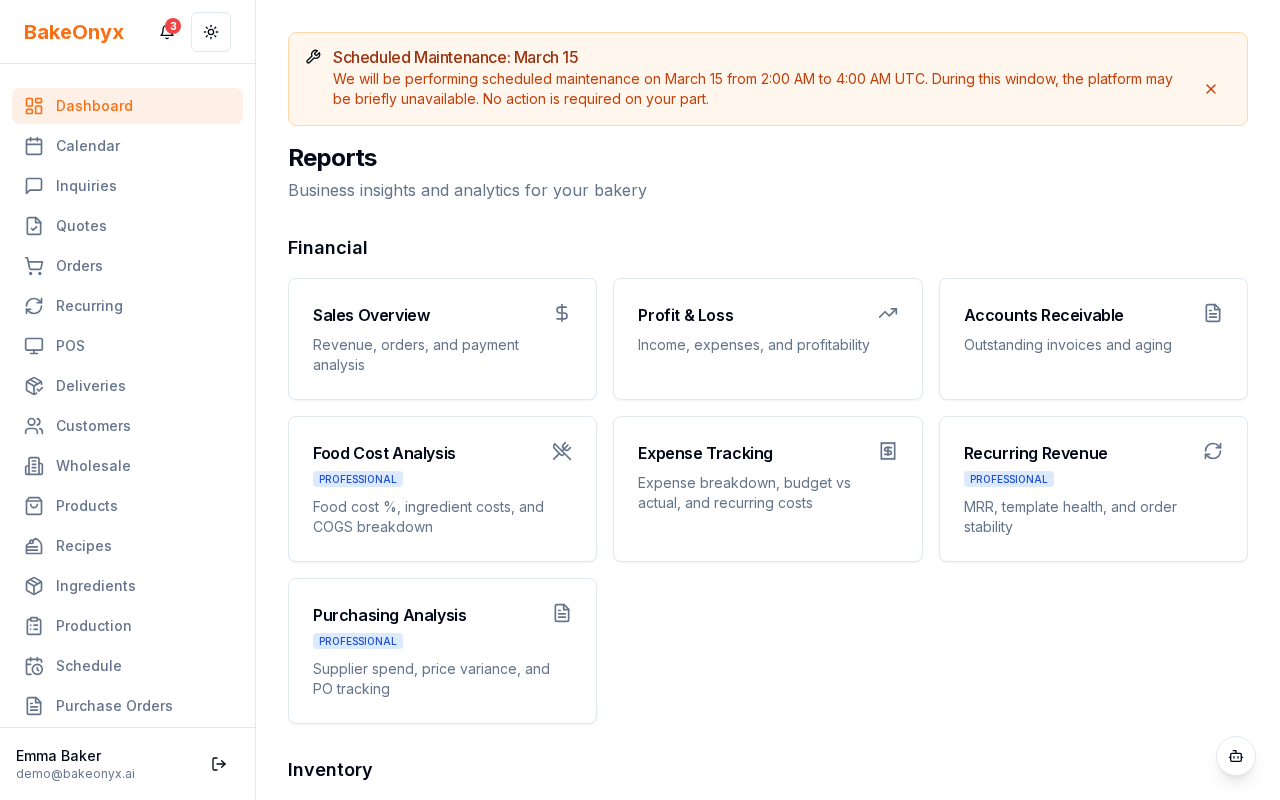
BakeOnyx tracks the numbers that show how your bakery is performing — revenue, profit margin, customer lifetime value, and retention. This guide explains what each one means and how to act on it, in plain language.
Core Revenue Metrics
Revenue
Revenue is the total income from all your orders before any costs are subtracted. This is the money customers pay you for cakes, pastries, and other baked goods.
Example: If you sell 10 cakes at $50 each, your revenue is $500.
Average Order Value (AOV)
Average Order Value tells you the typical amount a customer spends per order. To calculate it, divide your total revenue by the number of orders you've received.
Example: If you earned $2,000 in revenue from 40 orders, your AOV is $50 per order.
Use this metric to spot trends. If your AOV is dropping, customers may be ordering smaller items. If it's rising, your upselling efforts are working.
Profitability Metrics
Profit Margin
Profit Margin shows what percentage of your revenue is actual profit after all costs are paid. It's calculated as: (Revenue − Costs) ÷ Revenue.
Example: If you earn $1,000 in revenue and your costs are $600, your profit margin is 40%.
A healthy profit margin varies by bakery type, but most aim for 20–40%. Track this closely — if it's dropping, your costs are rising faster than your sales.
Customer Value Metrics
Customer Lifetime Value (CLV)
Customer Lifetime Value is the total amount a customer spends with you over their entire relationship with your bakery.
Example: If a customer orders from you 12 times over 2 years, spending an average of $75 per order, their CLV is $900.
High CLV customers are your most valuable. Focus on keeping them happy with great service and consistent quality.
Retention Rate
Retention Rate is the percentage of customers who order from you again. It shows customer loyalty.
Example: If you had 100 customers last month and 60 of them ordered again this month, your retention rate is 60%.
A higher retention rate is better — it's cheaper to keep existing customers than to find new ones.
Churn Rate
Churn Rate is the opposite of retention. It's the percentage of customers who stop ordering from you.
If your retention rate is 60%, your churn rate is 40%. Watch for increases in churn — it may signal a quality issue or that a competitor is taking your customers.
Sales Metrics
Quote Conversion Rate
Quote Conversion Rate measures how many customer inquiries turn into actual orders. It's calculated as: (Orders from quotes ÷ Total quotes sent) × 100.
Example: If you send 20 quotes and 8 become orders, your conversion rate is 40%.
A low conversion rate may mean your pricing is too high, your quotes lack detail, or customers are choosing competitors. Test improvements and track the results.
Using Metrics to Improve Your Bakery
Track these metrics monthly and look for trends:
- Is revenue growing or shrinking?
- Are customers ordering more or less frequently?
- Is profit margin staying steady or declining?
- Are quote conversion rates improving with your marketing efforts?
Use these insights to set goals, adjust pricing, improve customer service, and plan for growth.
Next Steps
- View your Profit & Loss Dashboard to see all metrics in one place
- Learn how to track expenses so your profit margin stays accurate
- Create and manage orders to build your customer data